How Long Can You Live With Bladder Cancer
What is screening?
Screening is looking for cancer before a person has any symptoms. This tin can help find cancer at an early stage. When abnormal tissue or cancer is plant early, information technology may exist easier to care for. By the fourth dimension symptoms appear, cancer may have begun to spread.
Scientists are trying to better sympathise which people are more probable to get certain types of cancer. They as well report the things we practise and the things around us to see if they crusade cancer. This data helps doctors recommend who should be screened for cancer, which screening tests should be used, and how often the tests should exist done.
It is of import to remember that your doctor does not necessarily call back you accept cancer if he or she suggests a screening test. Screening tests are given when you have no cancer symptoms.
If a screening examination result is abnormal, you may need to have more tests done to find out if yous have cancer. These are called diagnostic tests.
General Information Nearly Float and Other Urothelial Cancers
Cardinal Points
- Bladder and other urothelial cancers are diseases in which cancerous (cancer) cells form in the urothelium.
- Bladder cancer is more common in men than women.
- Smoking tin bear on the risk of float cancer.
Float and other urothelial cancers are diseases in which malignant (cancer) cells class in the urothelium.
The float is a hollow organ in the lower part of the abdomen. It is shaped like a small balloon and has a muscle wall that allows information technology to get larger or smaller to store urine fabricated by the kidneys. In that location are 2 kidneys, one on each side of the courage, to a higher place the waist. Tiny tubules in the kidneys filter and make clean the blood. They take out waste products and make urine. The urine passes from each kidney through a long tube called a ureter into the float. The bladder holds the urine until it passes through the urethra and leaves the body.
The urothelium is a layer of tissue that lines the urethra, bladder, ureters, prostate, and renal pelvis. Cancer that begins in the urothelium of the bladder is much more common than cancer that begins in the urothelium of the urethra, ureters, prostate, or renal pelvis. Considering it is the most common form of urothelial cancer, bladder cancer is the focus of this summary.
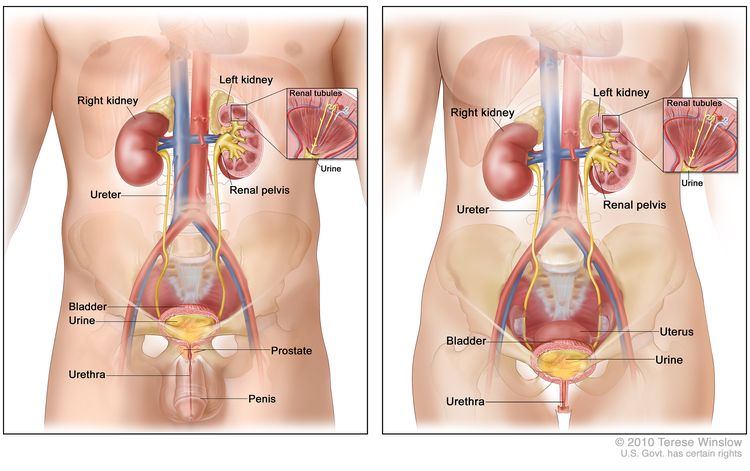
There are 3 types of cancer that begin in the urothelial cells of the bladder. These cancers are named for the blazon of cells that become malignant (cancerous):
- Transitional cell carcinoma: Cancer that begins in cells in the innermost layer of the bladder urothelium. These cells are able to stretch when the bladder is total and shrink when it is emptied. Most bladder cancers begin in the transitional cells.
- Squamous cell carcinoma: Cancer that forms in squamous cells (thin, flat cells that line the float). Cancer may form after long-term infection or irritation.
- Adenocarcinoma: Cancer that begins in glandular cells. Glandular cells in the float urothelium make substances such as fungus.
Run across the following PDQ summaries for more information near float and other urothelial cancers:
Float cancer is more mutual in men than women.
In the Usa, bladder cancer occurs more frequently in men than in women, and more often in White individuals than in Blackness individuals. Rates of bladder cancer have stayed nigh the same since the 1970s, although more recently (2008 to 2017), bladder cancer rates take been decreasing slightly each yr. Deaths from bladder cancer decreased in all races and sexes between 1975 and 2017.
Smoking can touch on the risk of bladder cancer.
Anything that increases your chance of getting a disease is called a gamble factor. Having a risk factor does not mean that you will get cancer; not having risk factors doesn't mean that you will non get cancer. Talk to your doctor if you call up you may be at hazard for bladder cancer.
Risk factors for float cancer include the following:
- Using tobacco, especially smoking cigarettes.
- Having a family history of bladder cancer.
- Having certain changes in the genes that are linked to float cancer.
- Being exposed to paints, dyes, metals, or petroleum products in the workplace.
- Past treatment with radiations therapy to the pelvis or with certain anticancer drugs, such as cyclophosphamide or ifosfamide.
- Taking Aristolochia fangchi, a Chinese herb.
- Drinking water from a well that has high levels of arsenic.
- Drinking water that has been treated with chlorine.
- Having a history of float infections, including bladder infections acquired by Schistosoma haematobium.
- Using urinary catheters for a long fourth dimension.
Older historic period is a take chances factor for most cancers. The chance of getting cancer increases every bit yous get older.
Screening for Bladder and Other Urothelial Cancers
Primal Points
- Tests are used to screen for different types of cancer when a person does not take symptoms.
- At that place is no standard or routine screening exam for bladder cancer.
- Hematuria tests have been studied every bit a way to screen for bladder cancer.
- Two tests may be used to screen for float cancer in patients who take had bladder cancer in the past:
- Cystoscopy
- Urine cytology
- Screening tests for float and other urothelial cancers are beingness studied in clinical trials.
Tests are used to screen for different types of cancer when a person does not have symptoms.
Scientists study screening tests to find those with the fewest harms and most benefits. Cancer screening trials also are meant to show whether early on detection (finding cancer before information technology causes symptoms) helps a person live longer or decreases a person's take chances of dying from the disease. For some types of cancer, the chance of recovery is ameliorate if the disease is plant and treated at an early on stage.
There is no standard or routine screening test for bladder cancer.
Hematuria tests take been studied as a fashion to screen for float cancer.
Hematuria (red blood cells in the urine) may be caused by cancer or past other conditions. A hematuria test is used to check for blood in a sample of urine by viewing it under a microscope or using a special exam strip. The test may be repeated over time.
Two tests may exist used to screen for float cancer in patients who have had float cancer in the by:
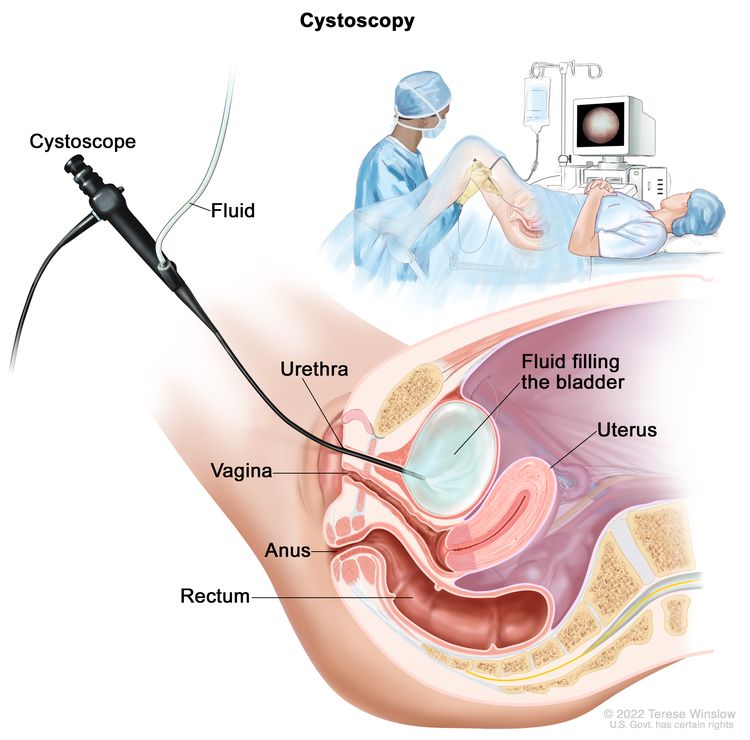
Cystoscopy
Cystoscopy is a procedure to look inside the bladder and urethra to check for abnormal areas. A cystoscope (a thin, lighted tube) is inserted through the urethra into the bladder. Tissue samples may be taken for biopsy.
Urine cytology
Urine cytology is a laboratory test in which a sample of urine is checked under a microscope for abnormal cells.
Screening tests for bladder and other urothelial cancers are being studied in clinical trials.
Information about clinical trials supported by NCI can exist found on NCI's clinical trials search webpage. Clinical trials supported by other organizations tin can exist found on the ClinicalTrials.gov website.
Risks of Screening for Float and Other Urothelial Cancers
Key Points
- Screening tests have risks.
- False-positive test results can occur.
- Simulated-negative exam results can occur.
Screening tests take risks.
Decisions about screening tests can be hard. Not all screening tests are helpful and most have risks. Before having any screening test, you may want to discuss the examination with your doctor. It is important to know the risks of the test and whether it has been proven to reduce the adventure of dying from cancer.
Fake-positive test results can occur.
Screening examination results may announced to exist abnormal even though no cancer is present. A false-positive test outcome (one that shows there is cancer when there really isn't) can cause anxiety and is usually followed by more tests (such equally cystoscopy or other invasive procedures), which besides have risks. False-positive results oft occur with hematuria testing; claret in the urine is usually caused past conditions other than cancer.
Imitation-negative test results tin can occur.
Screening test results may appear to be normal even though bladder cancer is present. A person who receives a false-negative test result (one that shows there is no cancer when in that location actually is) may filibuster seeking medical intendance even if at that place are symptoms.
Your doctor can advise you lot virtually your risk of bladder cancer and your demand for screening tests.
About This PDQ Summary
Well-nigh PDQ
Physician Data Query (PDQ) is the National Cancer Institute's (NCI's) comprehensive cancer information database. The PDQ database contains summaries of the latest published information on cancer prevention, detection, genetics, treatment, supportive intendance, and complementary and culling medicine. Most summaries come in two versions. The wellness professional person versions have detailed information written in technical language. The patient versions are written in easy-to-understand, nontechnical language. Both versions have cancer information that is accurate and up to date and nigh versions are also available in Spanish.
PDQ is a service of the NCI. The NCI is office of the National Institutes of Wellness (NIH). NIH is the federal government'southward center of biomedical enquiry. The PDQ summaries are based on an independent review of the medical literature. They are not policy statements of the NCI or the NIH.
Purpose of This Summary
This PDQ cancer information summary has current information about the screening of bladder and other urothelial cancers. It is meant to inform and help patients, families, and caregivers. It does not requite formal guidelines or recommendations for making decisions well-nigh health care.
Reviewers and Updates
Editorial Boards write the PDQ cancer information summaries and go along them up to engagement. These Boards are made up of experts in cancer treatment and other specialties related to cancer. The summaries are reviewed regularly and changes are made when there is new information. The date on each summary ("Updated") is the engagement of the about recent change.
The information in this patient summary was taken from the wellness professional version, which is reviewed regularly and updated as needed, by the PDQ Screening and Prevention Editorial Board.
Clinical Trial Information
A clinical trial is a study to answer a scientific question, such as whether one treatment is ameliorate than another. Trials are based on past studies and what has been learned in the laboratory. Each trial answers certain scientific questions in order to detect new and meliorate ways to aid cancer patients. During handling clinical trials, information is collected about the furnishings of a new treatment and how well it works. If a clinical trial shows that a new handling is better than i currently being used, the new treatment may get "standard." Patients may want to recall well-nigh taking part in a clinical trial. Some clinical trials are open only to patients who take not started treatment.
Clinical trials can be constitute online at NCI'due south website. For more information, telephone call the Cancer Data Service (CIS), NCI's contact center, at ane-800-4-CANCER (ane-800-422-6237).
Permission to Use This Summary
PDQ is a registered trademark. The content of PDQ documents tin can be used freely as text. Information technology cannot exist identified equally an NCI PDQ cancer data summary unless the whole summary is shown and information technology is updated regularly. However, a user would exist allowed to write a sentence such as "NCI'south PDQ cancer information summary about breast cancer prevention states the risks in the following fashion: [include extract from the summary]."
The best mode to cite this PDQ summary is:
PDQ® Screening and Prevention Editorial Board. PDQ Bladder and Other Urothelial Cancers Screening. Bethesda, Medico: National Cancer Establish. Updated <MM/DD/YYYY>. Available at: https://world wide web.cancer.gov/types/bladder/patient/bladder-screening-pdq. Accessed <MM/DD/YYYY>. [PMID: 26389218]
Images in this summary are used with permission of the author(s), artist, and/or publisher for use in the PDQ summaries only. If y'all want to use an prototype from a PDQ summary and you are not using the whole summary, you must get permission from the possessor. It cannot exist given past the National Cancer Establish. Information about using the images in this summary, forth with many other images related to cancer can be constitute in Visuals Online. Visuals Online is a collection of more than iii,000 scientific images.
Disclaimer
The information in these summaries should non be used to make decisions about insurance reimbursement. More than information on insurance coverage is bachelor on Cancer.gov on the Managing Cancer Care page.
Contact Us
More information about contacting united states of america or receiving aid with the Cancer.gov website tin can be constitute on our Contact Us for Assist page. Questions can also be submitted to Cancer.gov through the website'southward Electronic mail U.s.a..
Source: https://www.cancer.gov/types/bladder/patient/bladder-screening-pdq
0 Response to "How Long Can You Live With Bladder Cancer"
Post a Comment